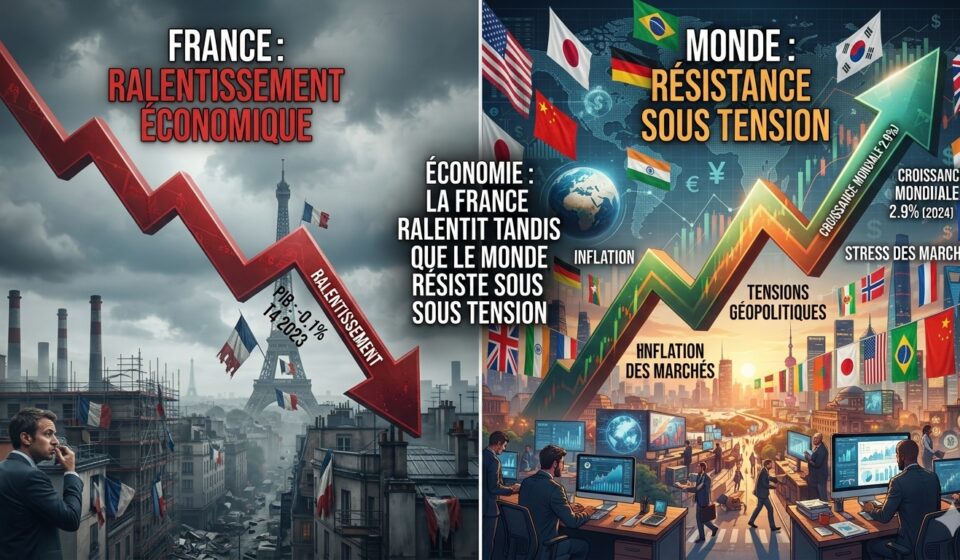

As of October 6, 2026, the French economy is facing a worrying combination of weak growth, renewed inflation and rising unemployment. The global economy appears more resilient, but it remains exposed to several major risks, including geopolitical conflicts, higher energy prices, trade tensions and elevated public debt.
This combination makes the coming months especially important for governments, central banks, households and businesses.
The French economy is close to stagnation
France is going through a period of weak economic activity. After contracting by 0.2% in the first quarter, gross domestic product remained flat in the second quarter of 2026. This indicates an economy that is not collapsing, but is also struggling to regain lasting momentum.
Household consumption, traditionally one of the main drivers of the French economy, is also showing signs of weakness. It fell by 0.5% in August. Several factors may explain this decline: households are becoming more cautious because of economic uncertainty, energy prices are rising and concerns about employment are increasing. Even when nominal wages go up, higher inflation reduces real purchasing power.
This situation is putting pressure on companies. Weaker domestic demand reduces sales and encourages businesses to postpone some investments or hiring plans. Business confidence has consequently deteriorated, with the relevant indicator falling to 96 in September, below its long-term average.
Inflation is making the situation more difficult
After slowing for a period, French inflation has started to rise again. Consumer prices increased by 3% year-on-year in September, largely because of higher energy costs.
This development matters because energy price increases gradually spread throughout the economy. Higher oil, gas and electricity prices raise transport, industrial production, heating and service costs. Companies can absorb these increases for a while, but they often eventually pass at least part of them on to consumers.
For households, the impact is particularly significant because many energy-related expenses are difficult to avoid, including housing, fuel, heating and food. Purchasing power per consumption unit fell by 0.6% in the second quarter.
The situation is also complicated for monetary policy. High interest rates can help bring inflation down, but they also weaken mortgage lending, business investment and household consumption. On the other hand, cutting rates too quickly could reignite price pressures.
The labor market is deteriorating
France’s unemployment rate reached 8.3% in the second quarter, up 0.2 percentage points from the previous quarter and 0.8 points over one year. Private-sector employment also edged down.
This deterioration comes as companies face weaker demand, higher costs and an uncertain international environment. Businesses often reduce hiring before making large-scale job cuts, meaning that the labor market can reflect an economic slowdown with a delay.
A 1.2% monthly increase in manufacturing output in August is a positive signal, but it is not enough to indicate a sustained recovery. A genuine rebound would need to be confirmed by several months of stronger production, as well as improved orders and investment.
Public finances remain under scrutiny
French public debt stood at 119% of GDP at the end of the second quarter of 2026. This high level limits the government’s room for maneuver at a time when the economy may need additional support.
Preparing the national budget is therefore a particularly delicate task. Reducing the deficit requires tighter spending controls, higher revenues or a combination of both. However, an overly restrictive fiscal policy could deepen the slowdown. Conversely, new spending could support economic activity in the short term while increasing debt and interest costs.
Financial markets are closely watching France’s ability to present a credible plan for reducing its deficit. If investors perceive fiscal risks as increasing, they may demand higher interest rates to finance French government debt. That would make borrowing more expensive and could further limit future policy options.
A more resilient but vulnerable global economy
The outlook is somewhat stronger at the global level. The International Monetary Fund forecasts global growth of 3.1% in 2026 and 3.2% in 2027. These figures represent moderate expansion, but they also show that the world economy continues to grow despite recent shocks.
This resilience is supported by technological investment, demand in several emerging economies and companies’ ability to adapt their supply chains. Investment linked to artificial intelligence is also supporting economic activity and financial markets.
However, several risks could alter this trajectory. Conflicts in the Middle East have pushed commodity prices higher and revived inflation expectations. Countries that rely heavily on imported energy are particularly vulnerable, as a more expensive energy bill weakens their trade balance and reduces household purchasing power.
Trade tensions are another major risk. Additional tariffs or a deeper fragmentation of international trade could make goods more expensive, reduce exports and disrupt industrial supply chains.
Finally, the optimism surrounding artificial intelligence contains an element of uncertainty. If the expected productivity gains materialize, they could provide long-term support for economic growth. But disappointment over technological or financial results could trigger a sharp correction in markets.
A high-risk period of transition
France is entering a difficult period marked by stagnation, inflation and rising unemployment. The global economy continues to grow, but remains exposed to energy, geopolitical and trade-related shocks.
The central challenge will be to restore confidence without allowing public debt to rise further, while also protecting purchasing power and employment. For households and companies alike, the coming months are likely to remain defined by caution.
France’s economic future will depend not only on domestic budgetary decisions, but also on developments beyond its borders. Energy markets, international trade, interest rates and geopolitical stability will all play a decisive role in determining whether the current slowdown remains temporary—or develops into a more persistent period of weakness.