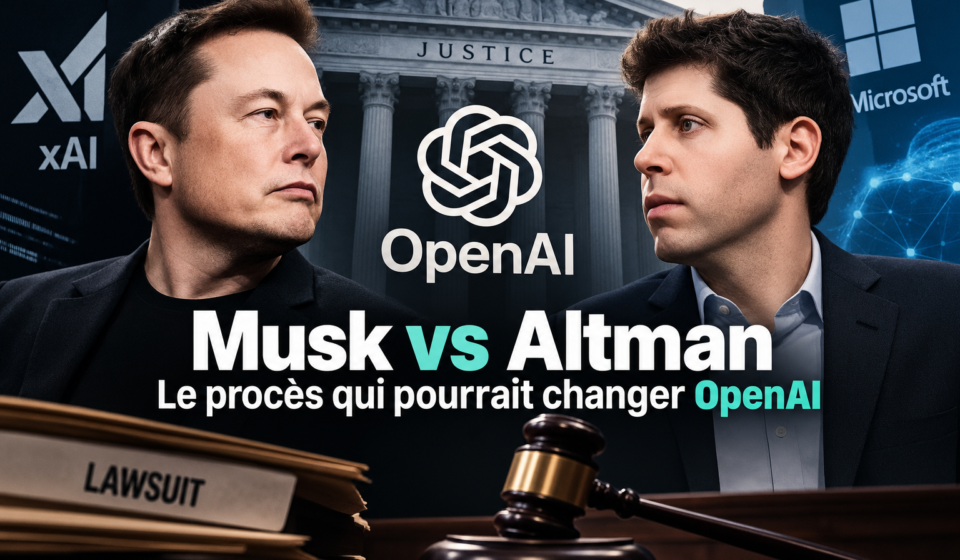

After Depp v. Heard, here’s the next legal drama Silicon Valley will be watching: Elon Musk vs. Sam Altman.
This time, there are no red carpets or paparazzi. But there are billions of dollars, the future of OpenAI and, behind it all, a fundamental question: who should control one of the world’s most powerful AI companies?
Why does it matter? The trial opens today and is expected to attract attention across the tech industry. The judge’s decision could have consequences for OpenAI’s corporate structure, its relationship with Microsoft and even its plans for a potential stock-market listing.
Let’s go back to the beginning.
In 2015, OpenAI was founded with a very different vision from the company we know today. Sam Altman, Elon Musk and their associates wanted to create a nonprofit artificial intelligence research lab, with a clear ambition: to develop AI that would benefit humanity as a whole and share its research.
Then things became more complicated.
In 2018, Elon Musk left OpenAI following disagreements over the company’s strategy. OpenAI subsequently evolved its business model, created a commercial structure and entered into a major partnership with Microsoft.
That transformation is at the heart of the lawsuit.
Elon Musk argues that OpenAI has moved away from its original mission. He is asking the court to reverse certain aspects of its transformation and is seeking up to $134 billion in damages.
He also argues that the $38 million he contributed to OpenAI in its early days should be treated as an investment. He is additionally calling for Sam Altman and Greg Brockman to step down.
OpenAI tells a different story.
According to the company, Musk knew that OpenAI would need a commercial model to finance its development. OpenAI also claims that Musk himself supported the idea of moving toward a for-profit structure and considered a potential partnership with Tesla.
At the center of the battle: 26%.
That is the share of OpenAI’s equity allocated to its nonprofit arm as part of its restructuring. Today, that stake is valued at more than $180 billion.
In other words, behind the public clash between Musk and Altman lies an enormous financial battle.
And the timing is anything but accidental.
Since 2023, Elon Musk has been building his own AI company, xAI, which aims, among other things, to compete with OpenAI. Meanwhile, OpenAI is pursuing further growth and preparing for the next stage of its transformation.
The trial therefore comes at a time when the two men are now leading competing AI ventures.
What happens next?
Several tech heavyweights are expected to testify, including Microsoft CEO Satya Nadella and Ilya Sutskever, OpenAI’s former chief scientist.
A verdict is expected in mid-May.
Until then, one question will remain at the heart of the case: should OpenAI remain faithful to the mission it was founded to pursue, or was it entitled to evolve in order to finance the race to build increasingly powerful AI?
A question that could ultimately extend far beyond the personal clash between Musk and Altman.